Ninety Feet of Judgment: Walking the Terrace With Our Maître d' on a Saturday Night
Photo: Didier Descouens, CC BY-SA 4.0, via Wikimedia Commons
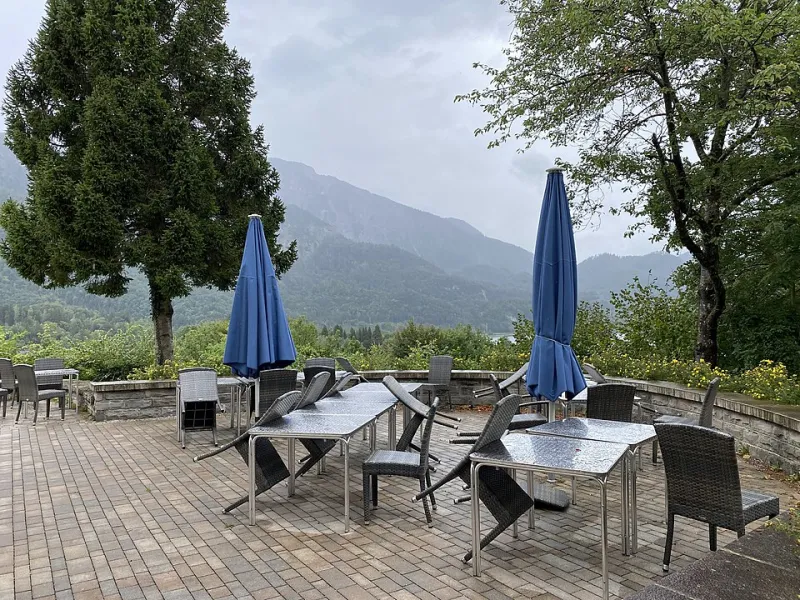
There's a stretch of floor at Ameku Terrace that guests never think twice about. It runs from the kitchen door, past the pass, along the railing that separates our dining room from the open sky, and ends wherever we seat you. On a menu it's nothing. In practice, it's the most scrutinized ninety feet in the building.
We asked Dani, our maître d' of six years, if we could shadow her for a Saturday service. She said yes, then immediately warned us: "You're going to get bored. It's mostly walking." It was not mostly walking.
The First Ten Seconds
Dani's evening starts long before the first reservation, but the real work begins at 6:12 PM on the night we followed her, when a party of four walks in eight minutes early. To a guest, this is simple: they arrived, they wait or they sit. To Dani, it's a ledger that updates instantly.
Table six is on entrees — they'll linger another forty. Table two just asked for the check, which means it opens in ten, not twenty. The couple at the rail has been watching the sky, which in late October means either they're cold or they're romantic, and she has about thirty seconds to figure out which.
She seats the foursome at table two. Nobody notices the math. That's the point.
"People think the job is greeting people," she told us later. "The job is predicting people. The greeting is just where the prediction becomes visible."
Reading the Sky, Reading the Room
On a terrace, the weather is a guest you can't comp a dessert to. Dani checks the radar three times an hour during shoulder season — not obsessively, just enough to know whether the wind is settling or building. When a gust line rolled in around 7:40 that night, she made two quiet calls: she steered a walk-in pair to an indoor two-top before they'd finished saying "outside would be nice," and she had the busser quietly move a candle and a throw blanket to table nine, where a couple was celebrating something they hadn't told us about but she'd clocked anyway.
The couple at the rail from earlier? Cold. She moved them inside without being asked, framing it as "we've got a table open by the window, if you want first pick." Guests rarely refuse a table they think they're getting away with something on.
The Art of the Slow Down
Here's something most diners never see: pacing is a service decision, not a kitchen accident. Around 8:15, the kitchen hit a rhythm and Dani made a call to slow the front of house down — coffees before the last course for one table, a longer beat between courses for another — because two large parties were due at 8:45 and the room couldn't digest them all at once.
"If I seat everything on time and pace everything on time, we lose the terrace," she said. "You can hear a rushed room. Out here, with the sky over your head, you came for the opposite of rushed."
So when your server lingers a beat too long at the next table before taking your dessert order, there's a decent chance that's not a flub. It's Dani, conducting.
Why the Walk Matters
By the end of the night — last seat around 10, kitchen closed at 10:40 — we asked Dani what she wishes guests understood about that ninety feet from the door to the chair. She thought about it longer than we expected.
"That it's the first course," she said. "Everything after the walk is food. The walk is the part where you decide whether you trust us. So we rehearse it. Which table, which light, which view, which mood. You only get one first walk."
The next time you're seated on a terrace — ours or anyone's — and the evening somehow feels easy, the sky cooperating and the timing invisible, consider that none of it was luck. Someone walked the room before you sat down, made a dozen small calls in your favor, and never mentioned a single one.
That's the job. Ninety feet at a time.