Turn Down the Volume, Turn Up the Street: How Our Terrace Sounds the Way It Does

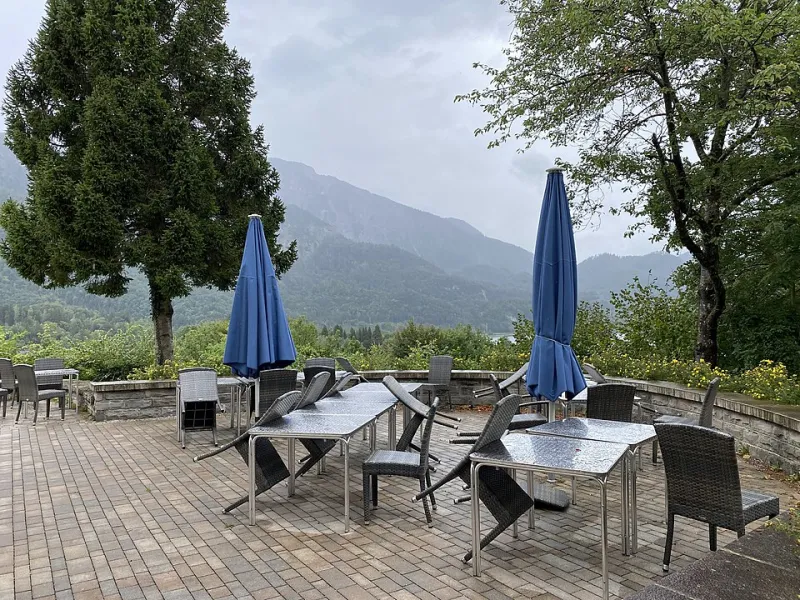
Photo: Pjotr Mahhonin, CC BY-SA 4.0, via Wikimedia Commons
Somewhere around 7:15 on a warm evening, a funny thing happens on our terrace: the music disappears. Not because a DJ quit or a speaker died — there never was one. What fades is your awareness of sound itself, because the mix underneath your conversation was tuned long before you sat down. It just wasn't tuned by a soundboard. It was tuned by cedar planters, canvas awnings, and a tape measure.
Why We Don't Pipe Anything In
Indoor restaurants fight silence. A quiet dining room feels tense, so speakers go up and playlists get curated to fill the gaps between tables. Out here, we made the opposite bet: the city already recorded an album, and it's better than anything we could license.
Street traffic hums at a low, steady register. Leaves in the planters add a high-frequency shimmer when the breeze picks up. Glassware contributes the occasional bright ping — a sound studies researcher would tell you that clinking stemware registers around 4 to 6 kilohertz, right in the range that reads as lively rather than chaotic to the human ear. We didn't engineer that. We just stopped getting in its way.
There's a practical reason too. Speakers outdoors have to fight wind and open sky, so volume climbs, conversation climbs to match, and suddenly four-top neighbors are shouting across two feet of tablecloth. We've all eaten at that patio. We didn't want to run one.
The Invisible Architecture
That said, an unmanaged terrace can sound like a bus stop. So the sound design happens structurally:
Planters as baffles. Our cedar boxes along the railing are planted with ornamental grasses and basil (the basil eventually migrates to the kitchen). Dense foliage scatters sound the way a bumpy wall scatters light — it breaks up the flat slap of traffic noise from the avenue into something softer and less directional.
Awnings that lean in. Our retractable canvas isn't just for rain or sun. Angled correctly, it reflects conversation back down toward the table instead of letting it float across the patio. On busy nights, the difference between awning-out and awning-open is roughly the difference between a dinner party and a food court.
Spacing as mixing. We run fewer covers than our square footage allows. Table spacing is the least glamorous tool in the box and the most effective. When you can't quite hear the couple behind you — just the shape of their laughter — the terrace feels full. When you can recite their order, it feels like a waiting room.
Choosing a Seat by Ear
Here's the part you can steal for any patio in America, not just ours.
If you want energy, sit near the entry or along the street side. Foot traffic, passing conversation, the low drama of a city block — it all pools there. It's the terrace equivalent of sitting at the bar.
If you want intimacy, head for the back corner, ideally with greenery on at least one side. Foliage is your friend; hard surfaces are not. A table backed by a brick wall will bounce every syllable back at you, which is great for eavesdropping and terrible for a first date.
And if you're booking for a group, ask about the table near the kitchen pass. On our terrace that's the loudest seat we have — and on a Friday night, that's exactly where a birthday party belongs. Sound you generate yourself never feels like noise.
One Last Thing to Listen For
The next time you dine outdoors, notice the moment the ambient sound stops registering. That moment is the design working. It means the traffic softened into texture, the clinks spaced themselves out, and the person across from you got a little easier to hear.
No playlist did that. Just wind, glassware, and somebody with a tape measure who cared.
Reservations for the terrace — corners included — are open on the site. Ask for the quiet seat. We know the one.