Two Empty Chairs, On Purpose: The Case Against a Perfectly Booked Night
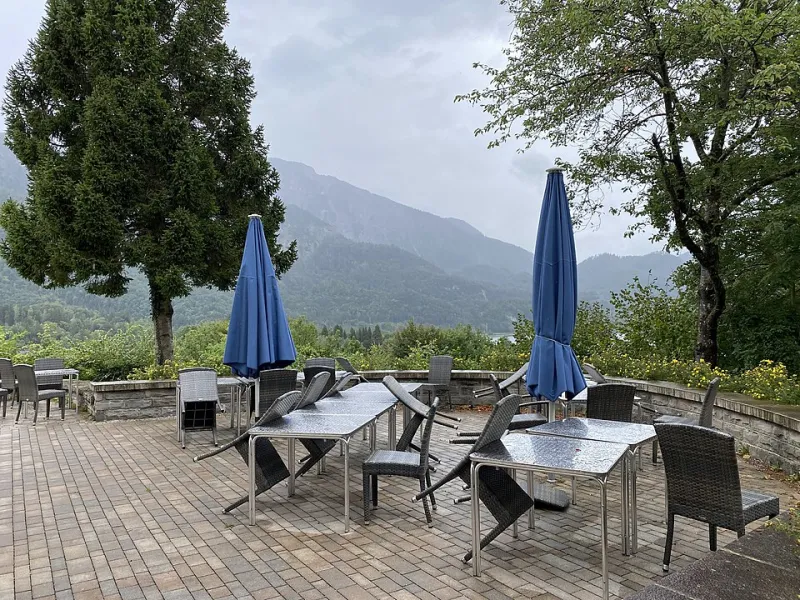
Photo: -wuppertaler, CC BY 4.0, via Wikimedia Commons
There's a spreadsheet in our back office that tells us, with reasonable accuracy, how much revenue we lose every night we hold a table open. It's a modest number. It is also, in our opinion, the cheapest insurance policy in the restaurant business.
Since last spring, Ameku Terrace has kept one — sometimes two — terrace tables unbooked each evening. No reservations. No waitlist. Just a small square of open-air real estate left to whatever the night brings. Guests ask about it constantly, usually with a squint that says that seems like bad math. This piece is our answer.
The Tyranny of the Full Book
American dining has never been more optimized. Reservation apps ping the moment a table opens. Dynamic pricing nudges you toward the 5:15 slot. Restaurants run yield management like airlines, and honestly, we get it — margins are thin, labor is expensive, and an empty table is a perishable product, like a seat on a flight to Denver.
But something gets lost when every chair is spoken for by 4 PM. A fully booked terrace is a machine running at capacity, and machines at capacity have no slack. No room for the couple who wandered in after a movie. No room for the regular who just needs one more hour under the string lights. No room, frankly, for the kind of evening nobody could have planned.
We run a terrace. The entire premise of this place is that the outdoors can't be scheduled — the breeze shows up when it wants, the sunset doesn't take bookings. It felt strange to run the front of house like a call center while the sky did whatever it liked above us.
What Happens at the Open Table
Here's the part we didn't expect: the unbooked table became the best seat in the house, not despite being free, but because of it.
There was the night in October when two strangers, both dining alone, ended up sharing it because it was the only table left and neither wanted to sit inside. They closed us down. They're married now — or at least they were last we heard, in a Facebook tag we're still slightly proud of.
There was the father and daughter who came in at 9:40 on a Tuesday, the night after his wife's memorial service, because he said the terrace was where she'd want them to eat. We had held the table without knowing any of that. We'd have held it anyway.
And there are the smaller stories, the ones that don't make it into staff-meeting retellings: the cyclist who rolls in sweaty at 8:30, the couple whose babysitter fell through and who arrive two hours past their original plan, the solo diner with a paperback who just wants the last hour of daylight. Walk-ins, latecomers, drifters. The reservation economy has quietly decided these people don't exist. We disagree.
The Business Logic Nobody Puts in a Pitch Deck
Fine — you came for the math, so here it is.
Holding one table out of, say, fourteen costs us a few covers a night. What it buys:
- A pressure valve. When a booking runs long or the kitchen hits a snag, the open table absorbs the overflow. Our comp rate and apology desserts have dropped noticeably.
- Walk-in goodwill. The people we seat at the open table are disproportionately likely to become regulars, because we said yes when three other places said we're fully committed.
- Staff morale. Servers like the open table. It's the one seat where they get to improvise, and guests feel that.
- Reputation. Half our word-of-mouth these days is some version of "they always seem to find room for you." You cannot buy that. Believe us, we've looked at the ad budgets.
There's also a subtler point. A restaurant that is always full is a restaurant that has stopped needing anyone in particular. The open table keeps us honest. It's a nightly reminder that hospitality is a verb, not a yield curve.
Leaving Room for Chance
We're not arguing that reservations are bad — book yours, please, especially for weekend golden hour, because the open table goes fast and we can't promise it. We're arguing that an over-optimized dining culture leaves no margin for the unplanned, and the unplanned is where a lot of the joy lives.
Every industry is fighting for efficiency right now. Efficiency is great for shipping boxes and booking flights. But dinner on a terrace, with the air cooling and the city humming below, has never been an efficiency problem. It's a luck problem. And luck needs a place to sit.
So the last seat of the night stays open. It costs us a little. It gives back more than the spreadsheet will ever show. Come find it sometime — no booking required, no guarantee either. That's sort of the whole point.